If you’ve ever been blocked, flagged, or banned while using a proxy, chances are you were using the wrong type. 4G mobile proxies are the most trusted proxy type on the internet — and in this guide, we’ll explain exactly why.
What is a proxy, and why does the type matter?
A proxy is a server that sits between your device and the website you’re visiting. Instead of seeing your real IP address, the website sees the proxy’s IP.
But here’s the catch: not all IPs are created equal. Websites and anti-bot systems classify IPs based on where they come from. And depending on the classification, your proxy can be instantly trusted — or instantly blocked.
There are three main types:
- Datacenter proxies — IPs from cloud servers (AWS, OVH, Hetzner…)
- Residential proxies — IPs from home internet connections (ISPs like Orange, Comcast…)
- Mobile proxies — IPs from cellular networks (4G/LTE from real carriers)
Each type has very different trust levels, detection rates, and use cases.
The three proxy types compared
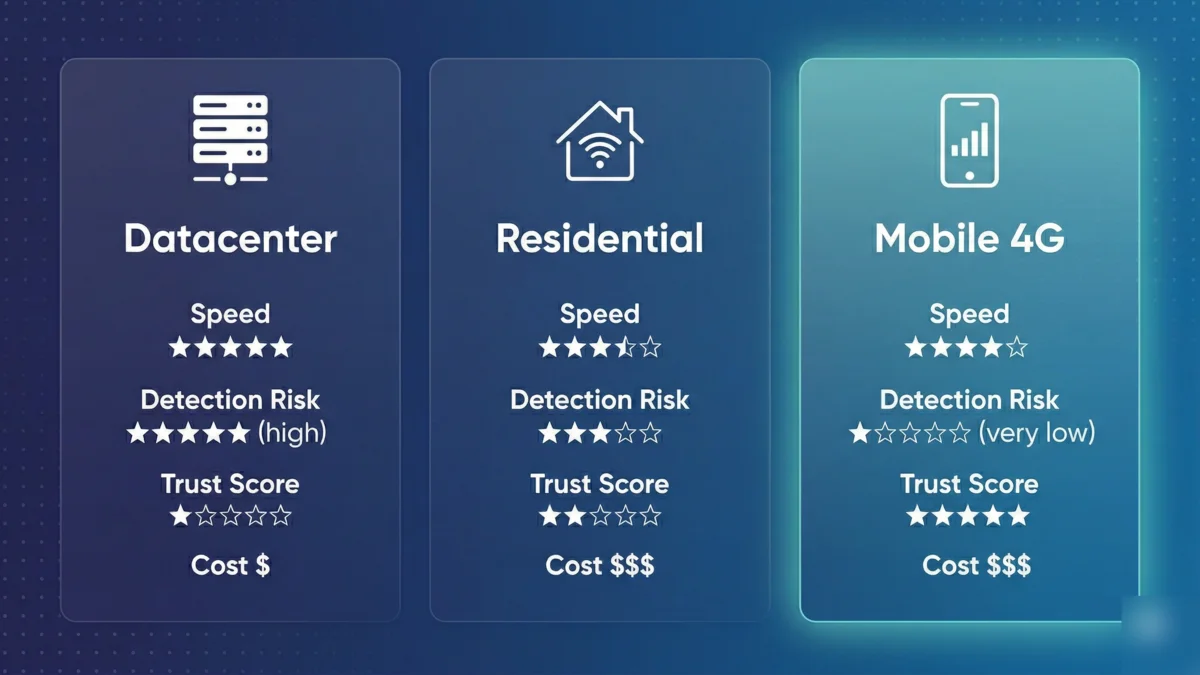
Datacenter proxies
Datacenter IPs come from servers hosted in data centers. They’re fast and cheap, but they’re also the easiest to detect. Anti-bot systems like Cloudflare, PerimeterX, and DataDome maintain databases of datacenter IP ranges and flag them automatically.
Best for: Basic scraping of unprotected sites, speed-sensitive tasks.
Worst for: Social media, anything with anti-bot protection.
Residential proxies
Residential IPs come from real ISP connections — the same kind of IP your home router gets. They’re harder to detect than datacenter IPs, but they have drawbacks: they’re often slow, expensive, and shared across many users simultaneously through large proxy pools.
Best for: General web scraping, geo-targeted research.
Worst for: Tasks requiring a stable, dedicated IP.
Mobile 4G proxies
Mobile IPs are assigned by cellular carriers (Orange, SFR, Bouygues Telecom, Free Mobile in France). They are the highest-trust IP type on the internet.
Why? Because of a technology called CGNAT (Carrier-Grade NAT).
Why mobile proxies are virtually undetectable
When you connect to a 4G network, your carrier assigns you an IP address. But that IP isn’t unique to you — it’s shared with thousands of other mobile users at the same time through CGNAT.
This means that at any given moment, a single mobile IP address is being used by:
- Someone scrolling Instagram
- A delivery driver using Google Maps
- A teenager watching TikTok
- A business person checking email
If a website blocks that IP, they’d block all of those legitimate users. So websites simply can’t afford to block mobile IPs aggressively.
This is why mobile proxies have:
- The highest trust score of any proxy type
- The lowest detection rate (under 1% on most platforms)
- The lowest ban rate for multi-accounting and automation
How a 4G mobile proxy works
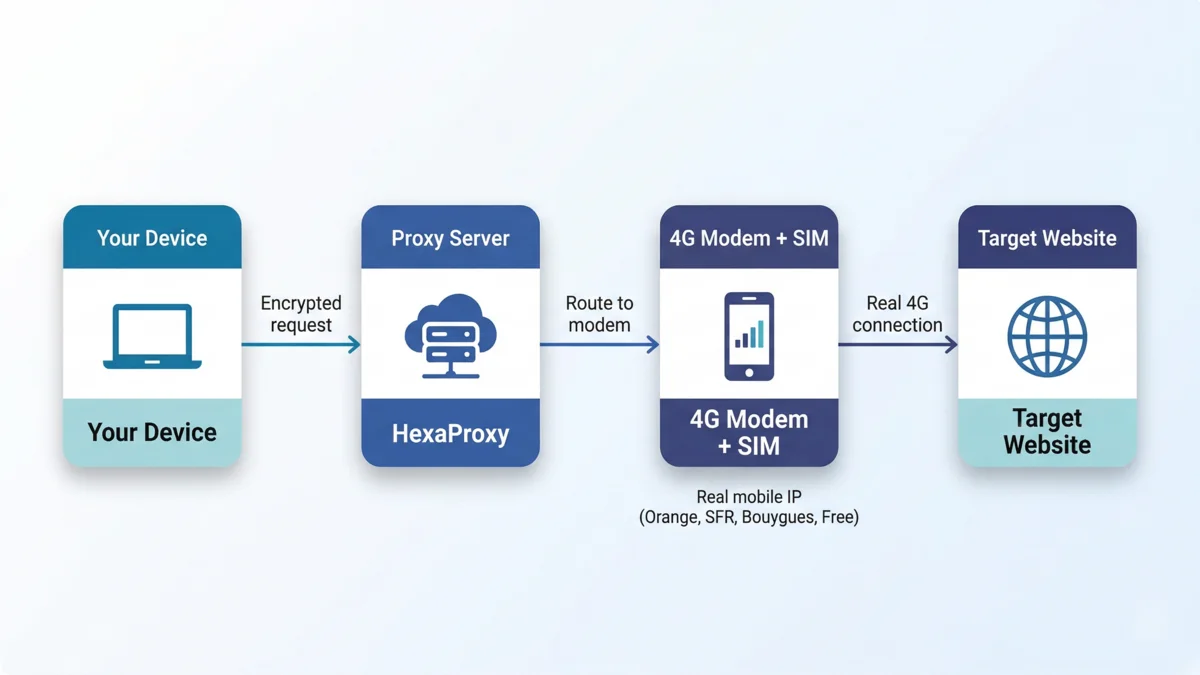
Here’s what happens when you use a 4G mobile proxy like HexaProxy:
- Your device sends a request (HTTP or SOCKS5) to the proxy server
- HexaProxy’s infrastructure receives your request and routes it to a physical 4G modem
- The 4G modem (with a real SIM card from Orange, SFR, Bouygues, or Free) connects to the mobile network and forwards your request
- The target website sees a real French mobile IP — indistinguishable from any regular smartphone user
The key difference from other proxy types: the connection goes through a real cellular network. There’s no emulation, no spoofing — it’s a genuine mobile connection with a genuine carrier-assigned IP.
IP rotation
Need a new IP? There are two ways:
- Automatic rotation — Configure intervals (every 5, 10, or 30 minutes) from the dashboard
- On-demand rotation — Trigger an instant IP change via the API or dashboard
Each rotation forces the modem to reconnect to the cell tower, which assigns a completely new IP address — exactly what happens when you toggle airplane mode on your phone.
Mobile vs. Datacenter vs. Residential: detailed comparison
| Feature | Datacenter | Residential | Mobile 4G |
|---|---|---|---|
| IP Source | Cloud servers | Home ISP routers | Cellular carriers |
| Trust Score | ★☆☆☆☆ Very Low | ★★★☆☆ Medium | ★★★★★ Very High |
| Detection Risk | ★★★★★ Very High | ★★★☆☆ Medium | ★☆☆☆☆ Very Low |
| Speed | ★★★★★ Fastest | ★★★☆☆ Variable | ★★★★☆ Fast (~150ms) |
| IP Uniqueness | Shared ranges, easily flagged | Shared pools | CGNAT shared, trusted |
| Stability | High | Low (rotating pools) | High (dedicated modem) |
| Cost | $ Cheapest | $$$ Expensive per GB | $$ Mid-range, unlimited |
| Best Use Case | Basic scraping | Geo-research | Multi-accounting, social media, scraping |
Real-world use cases for 4G mobile proxies
Social media management
Manage dozens of accounts on Instagram, Facebook, TikTok, or X (Twitter) without triggering “suspicious activity” alerts. Each account gets a unique, trusted mobile IP.
Multi-accounting on marketplaces
Run multiple seller accounts on Amazon, eBay, Vinted, or other platforms with French mobile IPs that match your account location.
Web scraping at scale
Scrape even the most protected websites (those using Cloudflare, DataDome, Akamai) without getting blocked. Mobile IPs bypass virtually all anti-bot systems.
Antidetect browsers
Pair HexaProxy with GoLogin, Dolphin Anty, Multilogin, or AdsPower for complete browser fingerprint control + trusted mobile IPs. The ultimate combo for stealth.
Ad verification
Verify that your ads display correctly in France with genuine French mobile IPs — see exactly what real mobile users see.
Why choose French 4G proxies specifically?
- Geo-targeting: Access French-only content, prices, and search results
- Platform trust: French social media accounts managed from French IPs look natural
- Legal compliance: Data collected from French IPs for French market research
- All 4 carriers: Choose between Orange, SFR, Bouygues Telecom, and Free Mobile for IP diversity
Getting started with HexaProxy
HexaProxy provides dedicated French 4G mobile proxies with:
- Dedicated IP — Your modem, your IP, not shared with other customers
- Unlimited bandwidth — No data caps, no throttling
- HTTP & SOCKS5 — Compatible with every tool and bot
- Auto-rotation — Fresh IPs on your schedule or on-demand via API
- Dashboard + API — Full control over your proxies
- 24/7 support — Via WhatsApp, Telegram, or email
Plans start at €5/day, €20/week, or €49.90/month per proxy. No commitment.